
Reef Bay Trail, St. John: Petroglyphs, Sugar Mill Ruins & What to Know Before You Hike
Planning to hike Reef Bay Trail in St. John? Learn about the trail, Reef Bay petroglyphs, historic sugar factory, difficulty, what to bring, and another way to visit Reef Bay by boat.

One of St. John’s Best Hikes Is Also a Walk Through Its History
Most visitors come to St. John for the beaches, but head into the mountains above Reef Bay and you’ll discover an entirely different side of the island.
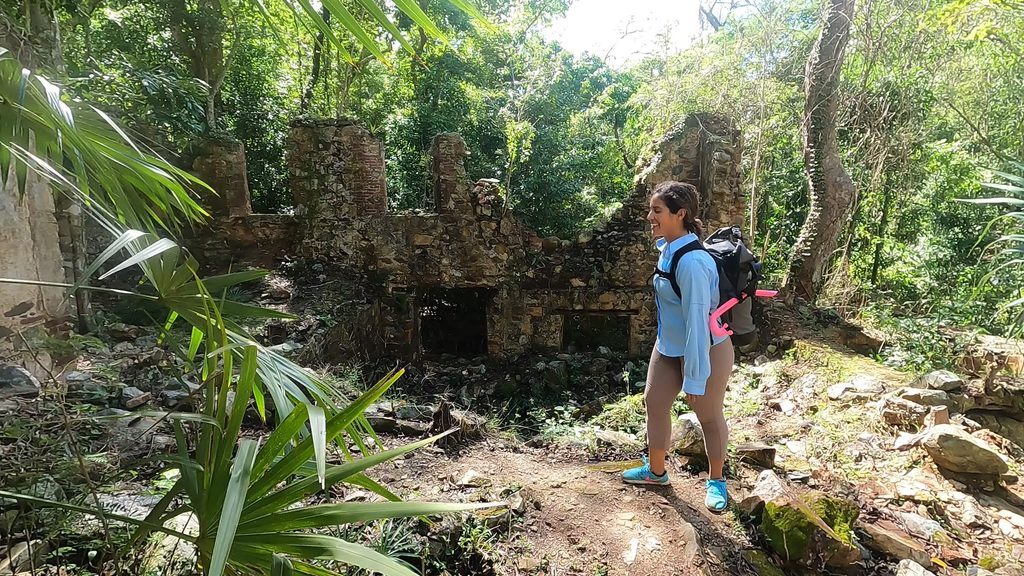
Reef Bay Trail descends through the forest of Virgin Islands National Park toward St. John’s remote South Shore. Along the way, hikers encounter old stone walls, plantation-era ruins, towering trees, Indigenous petroglyphs, and eventually the remains of the Reef Bay Sugar Factory near the coast.
It’s one of the most interesting hikes on St. John, but don’t mistake it for a casual stroll. The National Park Service classifies Reef Bay as a strenuous backcountry hike. The trail runs roughly three miles from the trailhead to the beach and drops approximately 900 feet in elevation, which means hikers have to regain that elevation on the return trip.
For those up for the challenge, Reef Bay offers something few other St. John trails can match: thousands of years of island history contained within one beautiful valley.
How Long Is the Reef Bay Trail?
The Reef Bay Trail is approximately three miles one way, running from St. John’s interior down to Reef Bay.
The National Park Service advises hikers to expect uneven and rocky terrain, steep sections, and potentially slippery conditions. The hike into the valley is the easy part to underestimate because almost all of the elevation lost on the way down must be regained on the return.
For the hike, plan to bring:
- Plenty of drinking water
- Food or snacks
- Sun protection
- Sturdy, closed-toe shoes
- Mosquito repellent
- A swimsuit if you plan to enjoy Reef Bay Beach
Before setting out, it’s also worth checking the National Park Service’s current Reef Bay Trail information for trail conditions, closures, and ranger programs.
What Will You See on Reef Bay Trail?
Reef Bay is a trail where the journey is just as interesting as the destination. The route passes through a landscape that has been shaped by people for centuries, even though much of that history is now hidden beneath dense forest.
According to the National Park Service, the trail passes remains associated with four former sugar estates before reaching the Reef Bay Sugar Factory near the shoreline. Along the way, visitors may encounter old agricultural areas, stone walls, estate roads, and historic structures.
This makes Reef Bay one of the best places on St. John to see how dramatically the island has changed. What looks like tropical wilderness today includes land that was once cleared, cultivated, traveled, and worked.
Take the Side Trail to the Reef Bay Petroglyphs
One of the highlights of Reef Bay requires a detour from the main trail. At approximately 1.6 miles, a side trail leads toward a spring-fed freshwater pool and waterfall containing the famous Reef Bay Petroglyphs.
These rock carvings are among St. John’s most fascinating connections to its Indigenous past. Faces and symbols were carved into the rocks surrounding the pool, and several sit just above the waterline. When the water is still, some of the carvings can actually reflect in the pool below.
Archaeological research conducted by the National Park Service connects many of these carvings with the development of Taíno culture and beliefs involving ancestors and the spiritual world. The exact meaning of individual carvings isn’t known, so it’s better to view these interpretations as part of an evolving archaeological understanding of the site rather than definitive translations of the symbols.
One important planning detail is that the petroglyphs are not located beside Reef Bay Beach or the sugar factory. They’re farther inland and require additional hiking.

Reef Bay Sugar Factory
Continue toward the coast and you’ll eventually reach one of St. John’s most interesting historic ruins: the Reef Bay Sugar Factory.
What makes this site unusual is how long it remained in agricultural production. The factory originally relied on animal power to crush sugar cane but was converted to steam power sometime after 1861, and portions of that machinery remain visible today.
Production continued decades after emancipation in the Danish West Indies in 1848. According to the National Park Service, Reef Bay was the latest-operating sugar factory on St. John, with operations finally ending after a fatal accident in 1908.
If you’ve already visited better-known ruins such as Annaberg, Reef Bay offers an interesting comparison because you’re seeing a site that continued evolving and operating into the 20th century.

Understanding the Plantation History of Reef Bay
Following Danish occupation of St. John in the early 1700s, much of the island was divided into agricultural estates. Sugar became particularly valuable, alongside crops such as cotton, tobacco, and food provisions.
The plantation economy depended upon the forced labor of enslaved Africans and their descendants, and that history is essential to understanding the ruins that survive today. These structures aren’t simply picturesque stone buildings in the forest; they’re physical remnants of a colonial economic system and of the people who were forced to build, maintain, and work within it.
After agricultural use declined, vegetation gradually returned. The forest visitors walk through today therefore represents both natural recovery and centuries of changing human land use.
How Was Sugar Made on St. John?
Understanding the basic sugar-making process makes the ruins much easier to interpret:
- Sugar cane was grown and harvested. Cane fields covered cleared areas of many estates, and the crop had to be cut by hand.
- The cane was transported to the mill. Heavy stalks needed to reach processing areas quickly after harvest.
- The cane was crushed. Large rollers squeezed juice from the stalks.
- The juice was boiled. Heating removed water and gradually concentrated the sugar.
- The leftover cane was reused. Crushed cane fiber, known as bagasse and historically as magass, could be dried and burned as fuel.
Sugar production was essentially an early industrial process performed in a difficult tropical environment. During the plantation period, every stage depended heavily upon enslaved labor.
Why Is the Sugar Factory So Close to the Ocean?
One of the easiest ways to understand historic St. John is to think of the ocean as the highway.
Today, visitors associate St. John’s water with beaches, snorkeling, and boat trips. Historically, the sea was also essential for transportation. The island’s steep terrain made moving people, equipment, supplies, and agricultural products over land difficult, making useful coastal access extremely valuable.
This perspective also helps explain why so much of St. John’s history makes sense when viewed from a boat. Places that seem isolated from modern roads were once connected through a transportation network centered on the sea.
Can You Visit Reef Bay by Boat?
Yes. The National Park Service notes that the Reef Bay Sugar Mill can be reached either by hiking or by boat.
When South Shore sea conditions permit, arriving by boat provides access to the lower portion of Reef Bay and the historic sugar factory without hiking approximately three miles down from St. John’s interior and then climbing roughly 900 feet back out.
We’ll admit our bias here — we’re boat people — but Reef Bay is one of the places where arriving from the water genuinely changes the experience. A South Shore boat day can combine the history of Reef Bay with swimming, snorkeling, and other destinations around Lameshur, Salt Pond, and St. John’s southern coastline.
Just remember that boat access to the sugar factory should not be confused with easy access to the petroglyphs, which are considerably farther inland.
Is Reef Bay Trail Worth It?
If you enjoy hiking, history, archaeology, and exploring beyond St. John’s beaches, Reef Bay is absolutely worth considering.
It’s probably not the best choice if you’re looking for a quick morning walk before heading to the beach. Instead, think of it as a real backcountry outing that rewards visitors with:
- Tropical forest and South Shore scenery
- Indigenous history and archaeology
- Plantation-era ruins
- The historic Reef Bay Sugar Factory
- A remote St. John beach
- A completely different perspective on Virgin Islands National Park
Few places on St. John tell as much of the island’s story within a single valley.
Reef Bay Trail FAQ
Want to See Reef Bay from the Water?
Reef Bay is a perfect example of why St. John looks different from a boat. Approaching from the South Shore provides a completely different perspective on the valley and, when conditions cooperate, an opportunity to visit the historic sugar factory without committing to the full hike down and back.
A boat day can also pair Reef Bay with Little Lameshur, Great Lameshur, Salt Pond, Ram Head, and South Shore snorkeling stops, creating an itinerary that combines history, scenery, swimming, and snorkeling rather than simply moving from one beach to another.
Sources & Further Reading
- National Park Service — Reef Bay Trail and Sugar Plantation
- National Park Service — Reef Bay Trail
- National Park Service — Petroglyphs of Reef Bay
- National Park Service — Indigenous Peoples of St. John
- St. John Historical Society — How Sugar Was Made on St. John During the Danish Colonial Period
- St. John Historical Society — A Brief History of Sugar and Sugar Production in the West Indies


