
Tektite Project on St. John: The Underwater NASA Experiment Where Scientists Lived for 60 Days
Discover the incredible story of Project Tektite on St. John, where scientists lived underwater for 60 days, NASA studied isolation, and Sylvia Earle led an all-women aquanaut team.
Scientists Once Lived Underwater Off the Coast of St. John
Today, the quiet waters around Great Lameshur on St. John’s South Shore are known for snorkeling, national park scenery, and a coastline that feels far removed from the island’s busier beaches.
In 1969, something very different was happening beneath the surface.
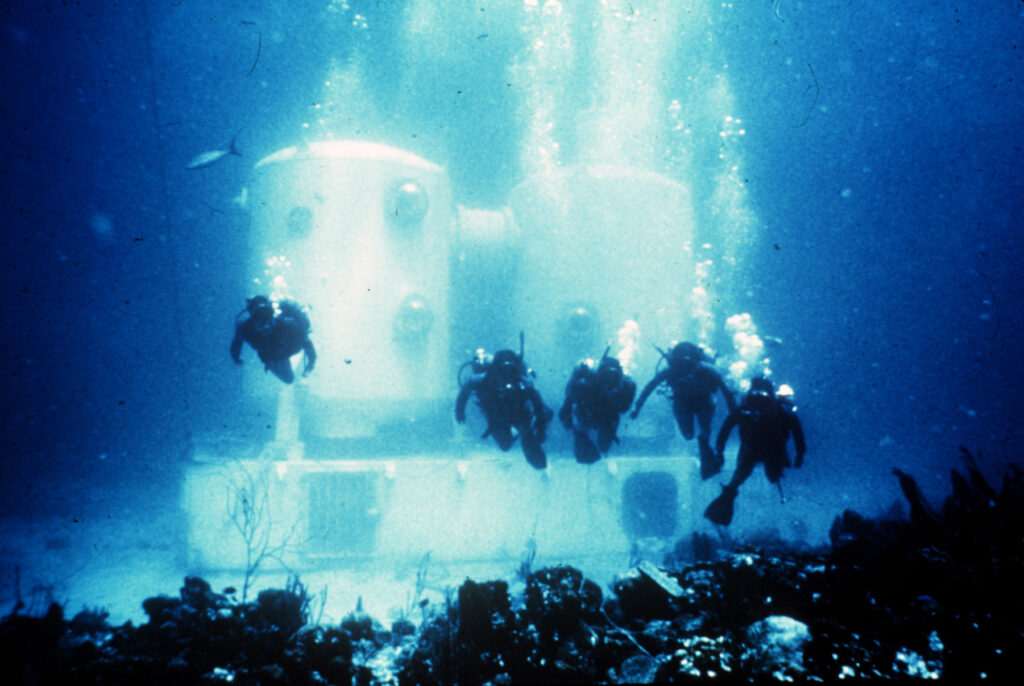
Four scientists climbed into an underwater habitat approximately 50 feet below the surface and stayed there for 60 consecutive days.
The experiment was called Project Tektite I, and it brought together the U.S. Department of the Interior, U.S. Navy, NASA, General Electric, and other organizations for an ambitious experiment involving marine science, underwater technology, human physiology, and psychology.
The scientists weren’t simply making long dives. They were living and working underwater, making this quiet corner of St. John part of an important chapter in the history of ocean exploration.
What Was Project Tektite?
Tektite was an experimental underwater laboratory and living habitat.
Normally, a diver’s time underwater is constrained by the need to return to the surface and manage decompression. Tektite used the principles of saturation diving, allowing aquanauts to remain under pressure for an extended period rather than decompressing after every excursion.
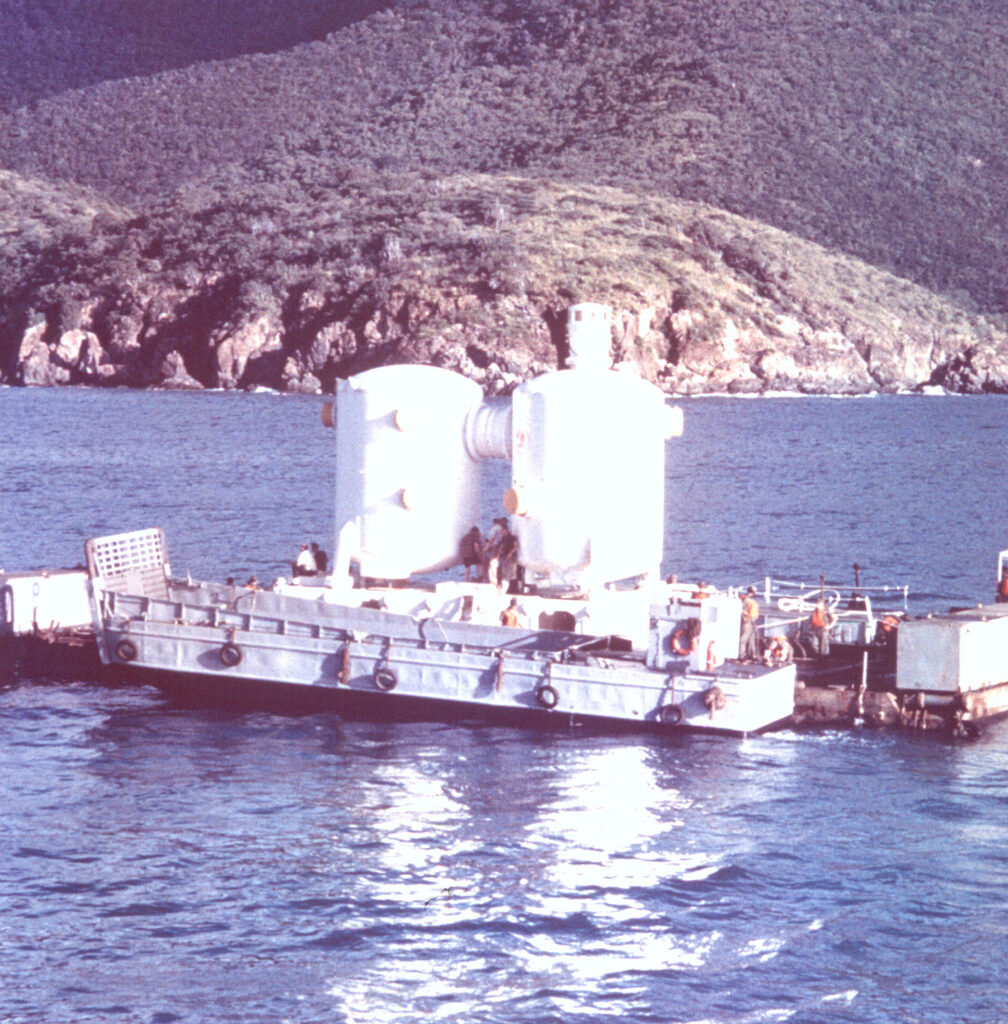
The Tektite I habitat sat at a depth of approximately 49–50 feet and consisted of two connected cylindrical structures rising from a base on the seafloor.
Inside, the aquanauts had the essentials required to live and work for an extended period, including areas for:
- Sleeping
- Preparing food
- Scientific work
- Communications
- Personal needs and hygiene
- Monitoring the habitat
- Entering and exiting directly into the ocean
For 60 days, this wasn’t simply their laboratory. It was their home.
Who Participated in Tektite I?
Four marine scientists made up the original Tektite I aquanaut team.
The program involved multiple federal agencies and private-sector partners, including:
- U.S. Department of the Interior
- U.S. Navy
- NASA
- General Electric
Other government, academic, and research organizations also provided support.
The mission ran from February 15 to April 15, 1969, placing the aquanauts underwater for 60 continuous days.
At the time, the project represented a remarkable experiment in how long people could successfully live and work under saturation-diving conditions.
Why Put Scientists Underwater for 60 Days?
Living underwater offered marine scientists an obvious advantage: time.
Instead of spending a large portion of every research dive descending, ascending, and managing decompression, aquanauts could leave the habitat and spend extended periods working directly in the marine environment.
Their work included research involving marine biology, geology, reef ecology, and other aspects of the surrounding environment.
But the marine research was only part of the experiment.
Scientists on the surface were also studying the aquanauts themselves.
Why Was NASA Involved in Tektite?
This is where the Tektite story gets particularly interesting.
NASA wasn’t primarily interested in St. John’s coral reefs. The agency was interested in what happened to people when they lived together for long periods inside a small, isolated environment where technology was essential for survival.
An underwater habitat shared several challenges with long-duration spaceflight:
- A small crew living together
- Limited personal space
- Physical isolation
- Dependence on life-support systems
- Confinement for extended periods
- Limited ability to simply leave
- Stress associated with living in an extreme environment
NASA researchers could observe behavior, mood, group dynamics, work performance, and the overall habitability of confined living quarters.
Tektite therefore became an early spaceflight analog — an extreme environment on Earth that could help researchers think about how people might eventually live and work on longer missions in space.
NASA later continued using underwater environments for similar reasons, making Tektite an interesting predecessor to more modern underwater space-analog programs.
Why Was St. John Chosen?
The Great Lameshur area provided an unusually useful natural laboratory.
Researchers had access to several marine habitats within a relatively small area, including:
- Coral reef
- Seagrass
- Sandy seafloor
- Rocky habitat
- Diverse marine life
- Warm tropical water
The area’s relative isolation also made it well suited for an experiment centered partly on confinement and separation from normal life.
For marine scientists, this meant they could study several different ecosystems without traveling far from the habitat.
That same underwater diversity remains part of what makes Tektite and the Lameshur area interesting for snorkeling today.
What Did the Tektite Habitat Look Like?
The Tektite I habitat looked something like two large cylindrical towers mounted side-by-side on the seafloor.
NASA records describe two interconnected cylinders approximately 18 feet high and 12.5 feet in diameter. The cylinders contained multiple compartments serving different purposes.
Rather than returning to a boat at the end of a research dive, the aquanauts could swim back to their underwater home.
The habitat allowed them to eat, sleep, work, communicate with the surface, and prepare for their next excursion without returning to normal atmospheric pressure.
It was essentially an underwater apartment, laboratory, and life-support system combined into one structure.
Tektite II Expanded the Experiment
The success of Tektite I led to the larger Tektite II program in 1970.
Rather than a single four-person crew spending 60 days underwater, Tektite II involved multiple missions and teams of scientists using the habitat for shorter periods.
NASA’s records describe Tektite II as having three major goals:
- Give marine scientists expanded opportunities for underwater research.
- Advance ocean science and technology related to humans working beneath the sea.
- Collect information about human behavior and habitability in small, confined living environments.
That third objective continued to make Tektite particularly relevant to NASA.
Sylvia Earle and Tektite II
One of the scientists who participated in Tektite II was Sylvia Earle, who would go on to become one of the world’s most recognized oceanographers and advocates for ocean exploration and conservation.
Earle participated as part of an all-women team of aquanauts, a milestone that became one of the best-known chapters of the Tektite program.
NOAA’s historical archives preserve photographs of Earle and her fellow aquanauts during the Tektite II program, including images of the team training, working in the habitat, and discussing their mission.
At a time when women were still largely excluded from many high-profile exploration programs, the mission demonstrated that women could perform the same demanding scientific and operational work in an extreme underwater environment.
The First All-Women Aquanaut Team
The all-women Tektite II team consisted of five marine scientists, with Earle serving as team leader.
Their mission wasn’t designed as a publicity stunt. They were there to conduct scientific research while living and working under the same demanding saturation conditions used by other Tektite crews.
The significance of the mission becomes even clearer when placed in the context of the era. NASA itself has since discussed Tektite II as one of the Earth-based analog environments that provided experience with women performing roles similar in some respects to astronauts years before women were admitted into NASA’s astronaut corps.
That makes this small bay on St. John part of both ocean-exploration history and the broader story of women in extreme-environment science.
What Was Daily Life Like Underwater?
Living beneath the ocean for days or weeks meant that ordinary activities suddenly happened in an extraordinary setting.
Aquanauts still needed to:
- Sleep
- Eat meals
- Complete scientific work
- Maintain equipment
- Communicate with colleagues
- Spend downtime together
- Manage interpersonal relationships
- Prepare for daily work outside the habitat
Researchers paid close attention to these routines.
NASA’s Tektite II habitability research examined mood, attitudes, use of leisure time, crew behavior, perceptions of living conditions, and other psychological factors.
That may sound mundane compared with exploring a coral reef, but those details are exactly what matter when you’re asking people to live together inside a confined environment for long periods — whether underwater or eventually in space.
Is the Tektite Habitat Still Underwater?
No. Visitors sometimes hear the Tektite story and assume there’s still an underwater laboratory on the bottom, waiting to be discovered.
The habitat and associated equipment were removed after the program ended.
There is no Tektite wreck or underwater building for snorkelers to find today. What remains is the location itself and the surrounding marine environment where the aquanauts conducted their research.
Can You Visit Tektite Today?
Yes. The Tektite area is adjacent to Great Lameshur Bay on St. John’s South Shore within Virgin Islands National Park.
Visitors can explore the larger Lameshur area from land, although the access road is rough and the National Park Service recommends four-wheel drive for reaching Lameshur.
The area can also be explored from the water.
For snorkelers, the small point near the Tektite Bay area is particularly interesting because of its large underwater boulders, channels, ledges, crevices, and changing depths.
We’ve covered that side of the destination separately in our Tektite snorkeling guide, because the snorkeling is worthwhile even if you know nothing about the history.
Knowing that scientists once lived and worked beneath these same waters simply makes the experience more interesting.u

Why Tektite Still Matters
Tektite sits at the intersection of several major ideas that were gaining momentum during the 1960s and 1970s:
- Humans exploring extreme environments
- The development of saturation diving
- Long-duration marine research
- Behavioral research relevant to spaceflight
- Women taking larger roles in exploration and science
- Growing scientific understanding of coral reef ecosystems
Some of the technology now looks dated, but the questions Tektite researchers were asking remain remarkably familiar.
How do humans live together in confined environments? How do we conduct science for extended periods underwater? Does isolation affect a crew? What makes a small habitat tolerable for weeks or months?
More than half a century later, those questions still matter to both ocean and space exploration.
Tektite Project FAQ
Final Thoughts on Project Tektite
Most visitors looking across the quiet water near Great Lameshur would never guess that this was once the site of an ambitious experiment involving marine scientists, the U.S. Navy, NASA, and some of the pioneers of underwater exploration.
That’s part of what makes the story so much fun to discover.
Tektite transformed a remote corner of St. John into an underwater laboratory where scientists studied the ocean while researchers simultaneously studied them. Tektite II expanded that experiment and helped put Sylvia Earle and an all-women aquanaut team into the history of underwater exploration.
The habitat may be gone, but the landscape that made the experiment possible is still here — and today, you can swim and snorkel through the same waters those aquanauts once used as their underwater workplace.
Sources & Further Reading
- NASA Technical Reports Server — Project Tektite I: A Multiagency 60-Day Saturated Dive
- NASA Technical Reports Server — Tektite II Habitability Research Program
- NASA Technical Reports Server — Tektite: Experience With an Underwater Analog of Future Space Operations
- NOAA — Undersea Explorers Historical Collection
- NOAA — Undersea Labs, Habitats & Observatories
- St. John Historical Society — Tektite Program Overview
- St. John Historical Society — Crystal Blue View of Tektite II
- National Park Service Research Archive — Tektite Program and Coral-Reef Fish Ecology


